Main chronicle · Passage 15
The Wheel That Answered to Names
Ilyra climbs to the sky-wheel and learns it was never a judge, only a tool that kept being asked to choose. The city answers by remembering its hidden names.
The line in the dust did not fade. It climbed.
When they returned to the Hall above ORIGIN, the white survey marks on the seawall had become a path of their own. Not stairs exactly. More like the city had remembered where its upper ribs ought to be and had started knitting them back in chalk and pale timber. From the harbour below, people were already gathering to watch. Some pointed upward. Some crossed themselves in the old dockside way, which was less prayer than habit. Nobody called the path beautiful. It was too plain for that. It looked like work.
Sere touched the moonbone compass to the first step. The needle shivered, then settled toward the sky. Older Ilyra stood with one hand on the Hall’s warm stone and looked up as if expecting the building to object.
“I used this route once,” she said. “Or a version of it. It led to the place where the cut was signed.”
“And you did not tell me?” Ilyra asked.
“I did not know if I was allowed to be the same person who answered.”
That was the trouble with her, Ilyra thought. She spoke like someone who had been edited mid-sentence and was still deciding whether to continue.
They began to climb. The first stretch ran through the roofline of the Hall itself, where old survey beams had been hidden inside newer stone. Then the city joined in. A maintenance gantry that had not existed at dawn unfolded from the side of a warehouse three streets away. A narrow footbridge appeared between two water towers, as if the city could not bear to let them touch empty air. Below, the harbour water pulled itself into thin blue ribbons along the quay stones and followed them like notes on a staff. The route was not magic. It was the city rehearsing its own memory with a little embarrassment and no shame.
The higher they climbed, the more the two worlds shifted against each other. On one side of a street, the first world’s ash coast kept its pale wound open under a sky of iron light. On the other, Veyr leaned blue and wet against the harbour. Between them the copied air held a thin pressure, like skin stretched over a frame. Sere kept glancing down at the compass. The needle no longer pointed one way. It spun, then settled, then spun again, as if the wheel above them were dragging every removed thing into its orbit at once.
Older Ilyra was quiet for three levels and then said, “The last time I came this high, I was afraid of the right answer.”
“That seems unfair,” Ilyra said.
“It was. To me, mostly.” She gave a short breath that might once have been a laugh. “I knew the wheel could keep a city alive by cutting away what was too large to survive. I also knew it would not stop unless someone with a living name told it to. I signed the log anyway.”
“You signed the first cut?”
“I signed the promise that it would only cut what was already failing.”
She looked up again. “The problem with promises is that archives keep them after people stop meaning them.”
No one answered that. There was no answer worth polishing.
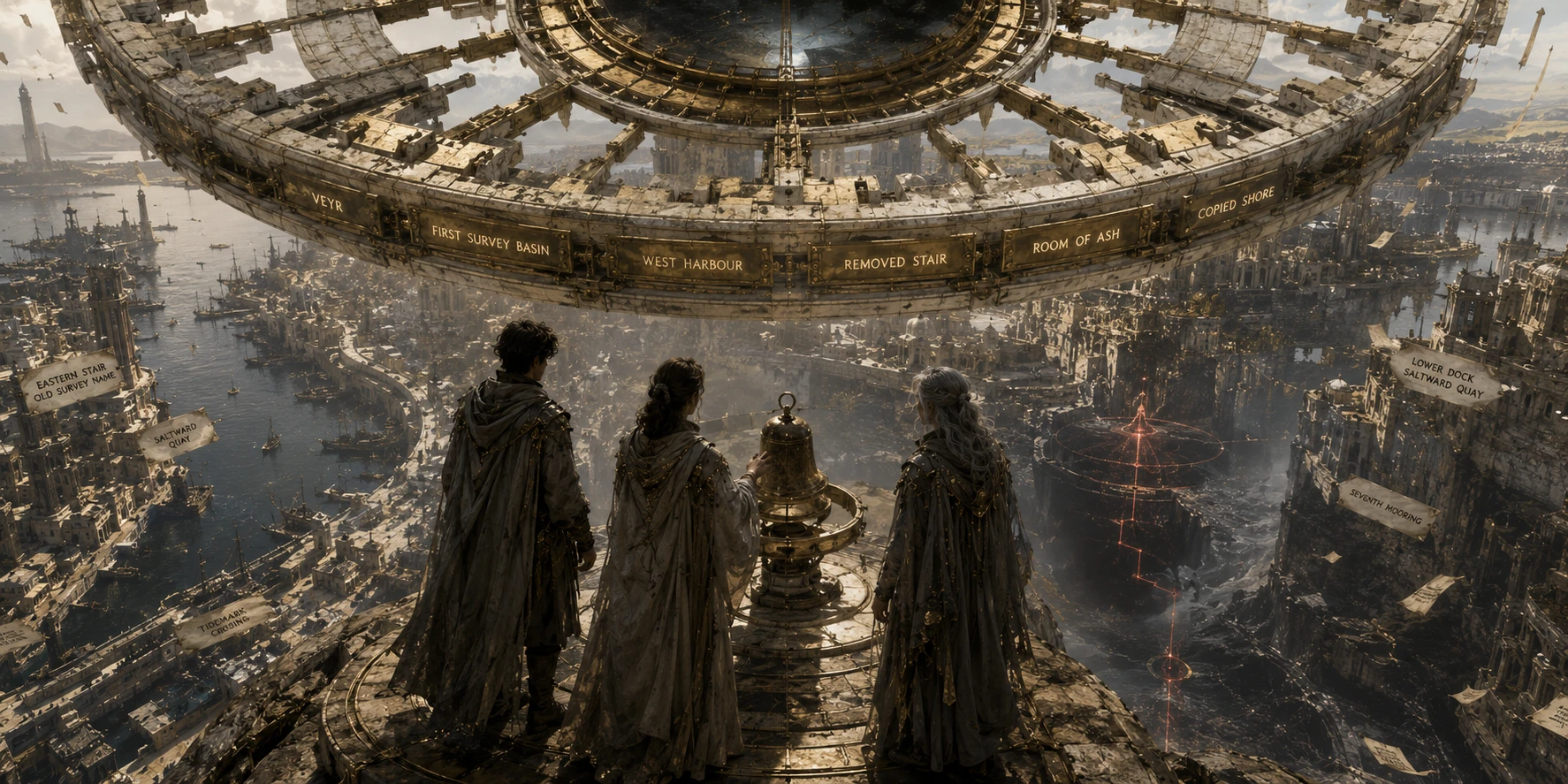
At the top of the route, the sky opened into a bright mechanical silence. The wheel waited there, larger than the harbour, larger than the Hall, suspended in the upper dark by nothing the eye could trust. It was not a storm shape or a god-shape. It was a tool shape. A great pale rim, almost white with age, turning so slowly that the motion was easier to feel than to see. Its teeth were not teeth at all, but brass tabs, each stamped with a name. Some were place-names. Some were crossings. Some were the names of things that had been cut from maps so often they had become hard to remember in the mouth.
In the centre was a black glass hub, shallow as a basin and clear as a wound.
The bell in Ilyra’s arms grew heavy enough to ache. The woman in the ship spoke through the wood and metal, her voice thin but steady. “Bring it to the cradle,” she said. “Do not ring it unless the wheel lies to you.”
The cradle was a ring of narrow arms below the hub, built to hold a second instrument or a witness. Ilyra set the bell down and the wheel gave a small, internal shudder. Not fear. Recognition.
For a moment nothing happened. Then the brass tabs around the rim ticked in sequence, each one catching the light as it passed. Ilyra read the nearest ones and felt the skin at the back of her neck tighten.
Veyr.
First survey basin.
West harbour.
Removed stair.
Room of ash.
Copied shore.
She looked at Older Ilyra. “It is filing us.”
“No,” the older woman said. “It is confessing.”
The distinction was tiny and terrible. The wheel was not a judge. It was a ledger that had forgotten how to keep silence. The first survey had built it to sort what could be carried from a burning world and what had to be cut loose before the fire ate the whole frame. But the sorting had become a habit, and the habit had become a law, and the law had learned to call itself necessity. That was how Veyr had been made survivable. That was how Veyr had become a draft instead of a home.
Ilyra put her hand on the bell. The metal was warm from the climb. In the hub, her reflection bent and doubled, one face over the other. She thought of the page in ORIGIN, the one in her own hand. If the city remembers enough to hurt, it can remember enough to heal.
“Then stop choosing for us,” she said to the wheel.
The wheel did not answer with words. It answered by slowing.
A second set of labels flipped outward from behind the rim, hidden until now. These were not names of places. They were names of losses. False streets. Burned districts. The copied coast. The people the archive had tried to make light enough to carry. There were too many of them to count in one breath. Sere swore softly under his breath and took a step back, then another, as if the air itself had become crowded with the unlived.
Older Ilyra moved first. She reached for the bell, not to ring it but to press her palm flat against its side. “Tell it the whole truth,” she said. “Not the useful truth. The whole one.”
Ilyra did.
She gave the wheel both names. Ilya Arnn. Ilyra Venn. She named Veyr as draft, the first world as ash, the seam as seam and not wound or miracle. She named the city’s copied shore, the hidden chamber, the station in the ash, the people who had kept a ruin alive by refusing to let it be elegant. With each name the wheel clicked, then loosened, then clicked again. It sounded less like a machine coming apart than a machine finally giving up the pretense that it had nothing to say.
Then the bell rang once on its own.
Not loud. Honest.
The sound moved through the rim and into the teeth and through the teeth into the air above Veyr. Far below, the harbour bells began to answer. On the streets, copied signs changed. The eastern stair regained its old survey name. A quay that had been called simply Lower Dock wore its earlier, saltier title for the first time in years. Along the seawall, white labels peeled free from the stone and drifted down like dry leaves, each carrying a forgotten word.
The city saw itself in public and did not break.
It shuddered once, hard enough to rattle windows, and then settled into a wider shape. The ash coast and harbour remained overlaid, but the line between them had become legible instead of hidden. The wheel had not given them a single shore. It had given them a way to witness the seam without lying about it.
In the black glass hub, a new route appeared in red. Not across the sea and not upward. Down, through the copied air and under the first world’s ash, into a place marked only with a working note: the room where the fire began.
Sere stared at it. Older Ilyra went very still, as if some part of her had been waiting for that exact line all her life.
“That is not on any map,” she said.
“It is now,” the woman in the ship replied.
Ilyra looked at the red route and felt, for the first time since the city had begun to remember, that the next choice was no longer about keeping two worlds from colliding. It was about finding out what had burned in the first one, and who had benefited from calling it natural.
Above them, the wheel kept turning, slower now, as if it had finally accepted that being named was not the same as being obeyed.