Main chronicle · Passage 14
The Drafting Table Between Worlds
Back in Veyr, the bell reveals the city has begun copying its own forgotten coastline into the streets, and Ilyra must decide whether to anchor the seam, expose the archive, or let both worlds speak at once.
The bridge back into Veyr did not so much end as thin out. One step the ash coast was under Ilyra’s boots; the next, the seam had become a bright, narrow causeway of waterless light, and beyond it the city waited in two versions at once. The harbour she knew sat clean and blue against its seawall. Over it, like a drawing laid too hard on a page, the first world’s coast lay in pale ash and black glass, the same angle of land, the same break in the line, the same wound carrying a different tide.
She held the bell close to her chest. It was heavier now, as if the ring she had drawn from it had added weight instead of sound. Sere walked at her shoulder with the moonbone compass cupped in both hands. It no longer pointed straight down. It kept twitching between the Hall of Measures and the harbour, as if the city had become a question with two correct answers. Older Ilyra came last, one hand braced against the invisible pressure of the seam. Her scarred mouth tightened when the harbour bells answered from the city side.
Not all at once, the answer came. First one bell. Then three. Then the low deeper note of the archive chimes, which had never rung outside the Hall before. Veyr was not flooding. It was copying. Streets were appearing under the seam in chalk-white lines, then settling into stone. The city’s old map logic had begun to run in public, and it was not choosing between shore and shore. It was laying one over the other until the difference itself became visible.
People had come to the quay by the time they reached the seawall. Keepers first, then dockhands, then a woman with a basket of pears who stood with her mouth open as the harbour water lifted in a narrow ribbon and traced a road along the stones. Nobody shouted. They were too busy watching the city remember itself badly and beautifully at once. A child pointed at a street sign that had changed while they watched. The name on it was one Ilyra had never seen and knew anyway: the old survey name for the eastern stair, the one the city had filed out of the public maps years ago.
“It’s waking too fast,” Sere said.
“No,” older Ilyra said. “It’s waking honest.”
The words stung because they were true. The bell had not mended the seam into something neat. It had loosened the lie that Veyr was singular. The city was beginning to remember the cost of being the surviving draft, and memory had a physical weight. On the quay, a section of paving lifted, trembled, and settled back with a second seam line beneath it, as if a street had just discovered there had always been a street under it.
Ilyra did not let herself stop. She crossed the quay toward the Hall of Measures while the city watched. The Hall’s whale-skin membranes were pitched outward, taut against the night, and now they were lit from within by two horizons: Veyr’s blue harbour, and the ash coast’s pale, wounded light. The living map at the entrance had gone pale around the edges. Its silver veins were moving, not drawing new land so much as admitting old land back into the frame.
Inside, the archive had opened its drawers by itself. Thin tabs of brass stood out from the shelves like teeth. Names hung in the air in a faint paper smell, and when Ilyra passed the first row of drawers she heard them whisper in the tiny dry voices of labels left too long in the sun. Some were places she had removed. Some were people. Some were roads. One drawer carried the name of a harbour she had never known, but when she touched the tab her hand remembered its salt.
“Do not leave me in the bell,” the woman in the ship said. Her voice came through the floorboards, through the map frame, through the basin in the entry hall where the surface water had begun to turn glass-clear. “It is not a grave. It is a hinge. Bring the hinge to the room where the cut was first made.”
Ilyra looked at Older Ilyra, who had gone very still. “ORIGIN,” she said.
The older woman gave a single sharp nod. “The drafting table.”
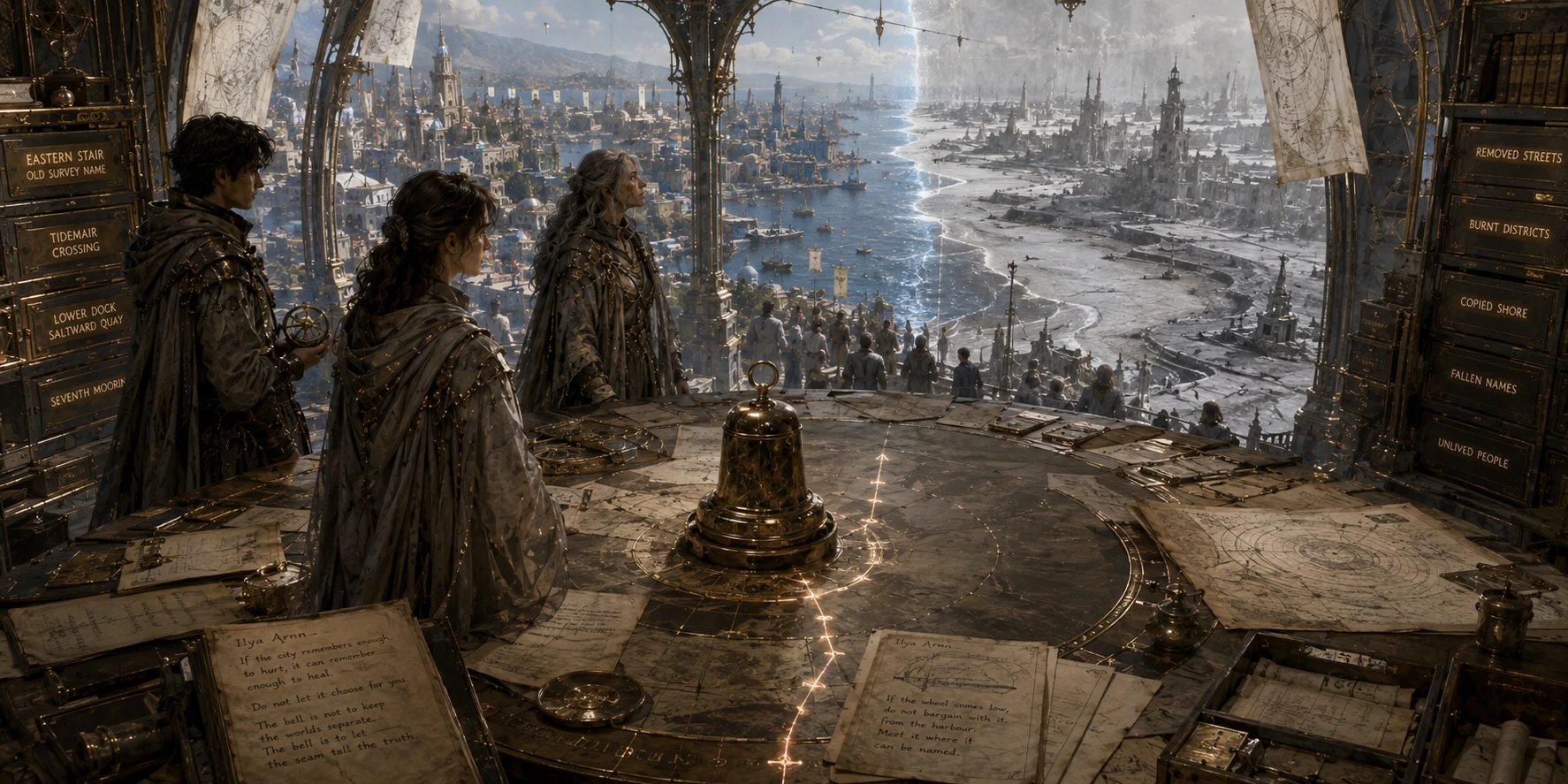
They took the bell below the Hall, into the chamber that had not existed on any public survey and yet had always been there in the bones of the building. ORIGIN smelled of whale-oil, dust, and the iron tang of old rain. The brass-ringed drafting table stood in the centre like an altar built by practical people. Around it were drawers, blank tabs, and folded skins of map parchment waiting to be told what they were for. The room hummed softly, not with magic, but with the held breath of work interrupted for years.
When Ilyra set the bell on the table, the sound it made was so low she felt it in her teeth. A strip of paper in the nearest drawer slid out by itself. Then another. Then a whole bundle of survey notes loosened and fanned across the surface. She read the top line and felt the room tip.
Not because of a new revelation. Because the truth was mundane.
The first survey had not been a mythic rescue. It had been a salvage operation after the world burned from inside. The copier in the sky had been built to repeat what could not be held, to cut away the collapsing portions, and to file the waste somewhere a frightened city could call ash. Veyr had been designed as a survivable draft, a place small enough to hold together by forgetting what had been too large to keep. The method had worked, until the forgetting became policy.
At the bottom of the stack was a page in her own hand. The ink had browned with age, but the strokes were still sharp. Ilyra read it once, then again, because the words refused to stay still.
If the city remembers enough to hurt, it can remember enough to heal.
Do not let it choose for you.
The bell is not to keep the worlds separate.
The bell is to let the seam tell the truth.
Under that note, in a second hand she recognised only by its patience, someone had added: If the wheel comes low, do not bargain with it from the harbour. Meet it where it can be named.
Sere made a small sound. He had found a chart among the pages, one Ilyra had not yet seen. He turned it toward her. On the paper, the sky-wheel was not a vague threat or a moving shape. It was drawn in plan and section, a huge circular mechanism hung over the world’s upper dark, its inner teeth marked with the names of the places it had cut away. Beneath it ran a route line in red: not across the sea, but straight upward through the copied air.
The chamber felt suddenly smaller. Through the floor, the city gave one deep shudder, like a ship changing its weight in water. Above them, the membranes of the Hall flexed once and held. The archive did not collapse. It answered. From the drawers came a soft, dry rustle as if whole districts were turning in their sleep.
Older Ilyra put one hand flat on the drafting table. “It knows we have seen it,” she said.
“It will come back,” Sere said.
The woman in the ship laughed once, and it sounded more tired than amused. “It never left. It only waited for a world that would admit its own copy marks.”
Ilyra lifted the bell again, not to ring it, but to carry it. The room around her was full of names and edges and the smell of paper warmed after rain. She understood that the next step was not another choice between worlds. It was a choice about honesty. The city could keep living only if it stopped pretending the missing had been cleanly lost. The bell would have to be taken to the surface. The archive would have to be opened in public. The copy would have to be shown its source.
When they emerged into the Hall, the quay bells were still ringing. Veyr had not split. It had steadied into a tense, doubled alignment. The harbour on one side of the glass and the ash coast on the other now shared the same horizon line. Along the seawall, the first of the white survey marks had begun to glow in daylight, a route the city had once hidden and was now unable to ignore. In the brass rim of the bell, Ilyra saw her own reflection overlaid with another face behind it, the older version of herself standing at the edge of a road that ran upward into the sky.
A new line was appearing in the draft table’s dust, drawn by no hand she could see. It did not point to the harbour, or the basin, or the coast. It pointed up.