Main chronicle · Passage 16
The Room Where the Fire Began
Ilyra, Sere and Older Ilyra descend into the sealed room beneath the ash route and learn the first fire was not weather but a policy choice made by the archive and the wheel. The ember still lives, and waking it could restore the lost sequence—or relight every hidden name in Veyr.
The red route did not behave like a stair. It moved under their feet in sections, as if the city had remembered a buried corridor and was laying it out one plank at a time. Above them, the wheel kept turning in its patient, metallic silence. Below, the ash coast on one side and Veyr on the other slipped and overlapped like two transparencies pressed together and heated at the edges.
Older Ilyra went first. She did not look back to see whether the route had changed its mind. Sere followed with the moonbone compass held low against his chest, the needle flickering so fast it looked less like direction than alarm. Ilyra came last, one hand sliding along the copied air where the world felt thin and warm, almost elastic, almost alive.
The route brought them to a hatch built into the underside of a survey ledge that should not have existed. Its iron had gone brown with age and salt, but the locking plate was still polished where hands had touched it for years. A brass tab hung from the ring on a chain so short it could only ever have been meant for one thing: telling a witness where to stand.
On the tab, in half-ablated letters, was a working note:
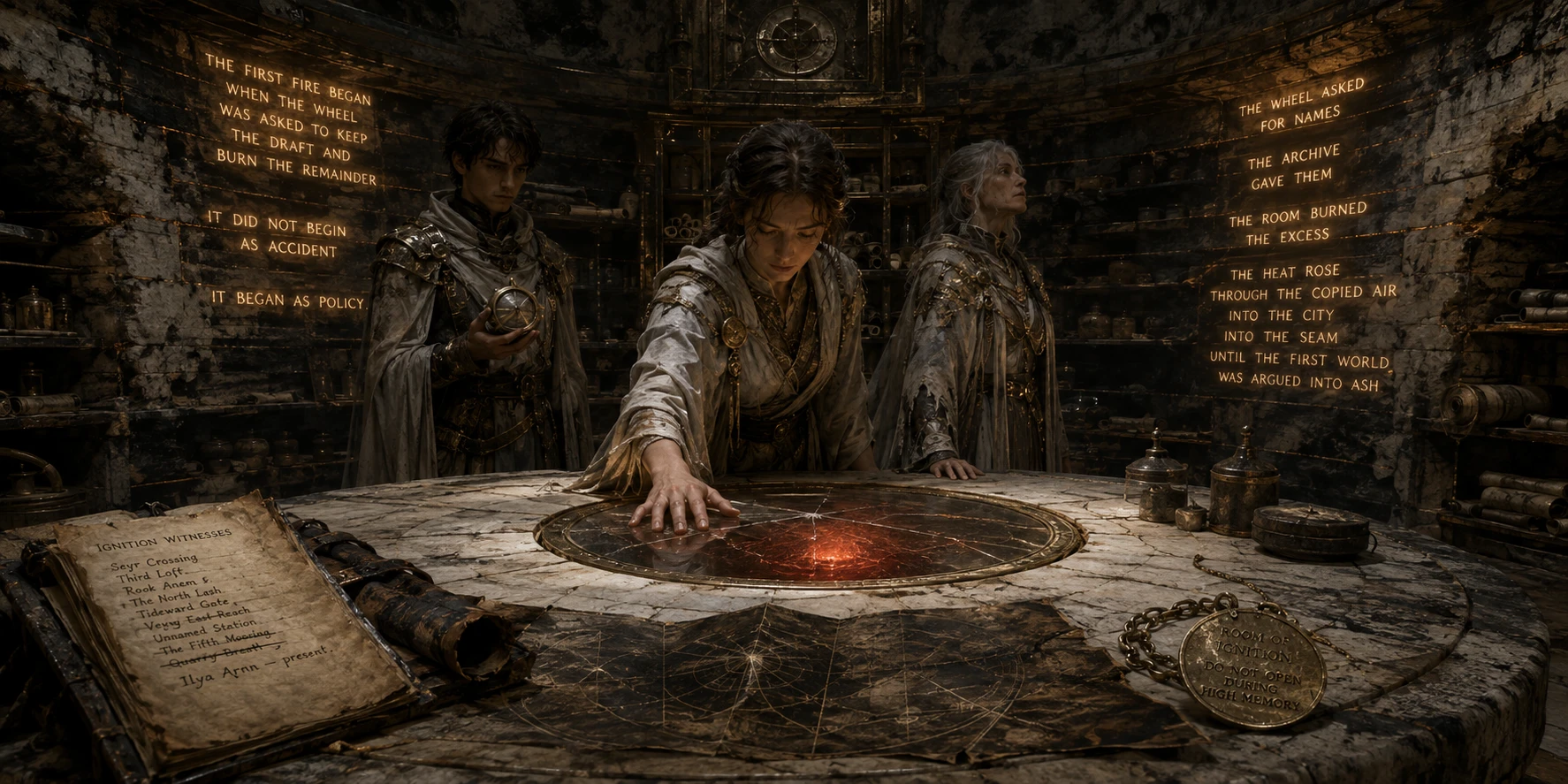
ROOM OF IGNITION — DO NOT OPEN DURING HIGH MEMORY
Sere stared at it. “That is a terrible name for a room.”
“It was never meant to be a room,” Older Ilyra said. “Only the place where the first lie caught.”
Ilyra looked at her. “You knew this was here.”
“I knew it existed,” the older woman said. “I did not know whether we would be allowed to arrive.”
The woman in the ship spoke through the bell’s wooden side, her voice thin but sure. “Open it,” she said. “There is no remaining value in waiting for courage.”
The hatch gave way after Sere slipped the compass point into the seam and twisted. The seal did not squeal. It sighed, as if the room beneath had been holding its breath for years and had finally decided to let go. Warm air rose at once, carrying the smell of ash, wet stone, and something older: singed vellum, the sharp metallic edge of a storm struck by flint.
They descended into a circular chamber cut directly into black bedrock. The walls had been dressed once with white plaster, now blistered and scarred in bands, as though fire had walked the room in a slow, deliberate spiral and paused at each mark to read it. Shelves ran around the perimeter. Most were empty. A few still held blunt survey weights, cracked oil lamps, and charred map tubes collapsed like spent bones.
In the center stood a table of pale stone with a shallow brass basin set into its middle. The basin was dry. What remained inside it was not water, not ash, but a fused sheet of glass so thin it looked poured rather than melted. Under that glass something glowed, no larger than a knuckle, a coal-red point that brightened and dimmed with each breath anyone took in the room.
Sere stepped back at once. “That is still hot.”
“Not hot,” the woman in the ship murmured. “Listening.”
Ilyra moved to the table before anyone could stop her. On the edge, under a skin of soot, lay a ledger bound in whale-skin gone dark as bark. The first page had been burned away. The second was intact. She lifted it carefully and saw that the entries were not dates. They were instructions.
Route 9: preserve the harbour line.
Route 12: remove the impossible shore.
Route 18: keep enough of the city to make witnesses believable.
Her throat tightened.
The next page had been written in the same hand as the route note in ORIGIN. Not hers exactly. Older. More pressed. A hand that had stopped believing neatness would save anyone.
When the archive asks for a clean cut, do not trust the person who says necessity. Fire is what the wheel calls the moment it can no longer keep a world in one piece. It will blame the fuel. It will never blame the hand that fed it names.
Sere drew in a breath through his teeth. Older Ilyra closed her eyes as if struck.
“You wrote this,” Ilyra said quietly.
Older Ilyra did not open her eyes. “Yes.”
“Then you know who lit it.”
“I know who signed for the room to exist.” She swallowed once. “That is not always the same answer.”
Ilyra turned another page. Beneath the instruction block, the ledger had a section headed Ignition Witnesses. The names listed there were not all names in the ordinary sense. Some were stations. Some were crossings. Some had been struck through and restored by hand so often the paper itself had thinned. But one line was untouched.
Ilya Arnn — present.
Her fingers went cold.
“That is me,” she said.
The room answered before anyone else could. The coal in the glass basin brightened sharply, and the ash bands on the walls lit in sequence, revealing more writing hidden under the soot. Words appeared in the plaster like scars whitening under pressure.
The first fire began when the wheel was asked to keep the draft and burn the remainder.
It did not begin as accident.
It began as policy.
For a moment nobody moved. The room had the stunned stillness of a thing that had expected to be denied forever and had finally been believed.
Sere looked from the wall to the glowing basin. “So the fire was not weather.”
“No,” Older Ilyra said. Her voice had gone rough. “It was a decision.”
The woman in the ship spoke again, and this time there was pain in the thinness of her voice. “There was a first survey board,” she said. “There were two camps. One wanted the wheel to preserve the surviving city by cutting away what could not be carried. The other wanted to burn the machine before it learned to make that choice on its own. The room below them was built for emergency clean-out, to burn drafts and false routes when the archive was collapsing under contradictory memory.”
She paused.
“Someone fed it a whole world-name.”
Ilyra turned toward the basin. The coal inside the glass had become a tiny red eye. “Who?” she asked.
No one answered at once. Older Ilyra’s jaw tightened, as if she were wrestling a word out of a locked room in her own skull. Then she said, very quietly, “I think I did.”
The chamber seemed to lean toward her.
“Not as I am now,” she said. “As the one who still believed a clean cut could be kinder than a messy survival. We were trying to stop the wheel from making a public choice. We thought if we burned the copied routes before they spread, we could save the remainder.”
Sere laughed once, but there was no humor in it. “And instead you built the fire into the archive.”
Older Ilyra looked at him with the exhausted honesty of someone who could no longer afford mercy toward herself. “Yes.”
They read the wall together after that. The room had preserved the event in layers: not a single instant, but a sequence of compromises. The wheel had asked for names. The archive had given them. The room had burned the excess. The heat had climbed through the copied air and into the city above, then into the seam between worlds, until the first world had not merely burned but been argued into ash from the inside.
What remained in the basin was not a relic of the blaze. It was the ember the room had never succeeded in extinguishing. A living remainder. A witness that had learned to survive by becoming small enough to overlook.
Ilyra reached for the whale-skin ledger again and found, tucked into the back cover, a folded strip of map paper so blackened it could only be opened with care. Her own handwriting scratched across it in a line she did not remember making:
If you find the room, do not ask who lit it. Ask what they were trying to save.
Under that, a second line.
If the answer is Veyr, you will hate it. If the answer is both, you will have to learn to carry what was called impossible.
The coal in the basin brightened again, and the glass over it spidered with a new crack. Through the crack, Ilyra saw not flame but a moving field of labels, stacked like the wheel’s rim, all the names the city had hidden and all the names it still refused to surrender. One of them was hers. Another was the first world’s. A third was the room itself.
Then a fourth label surfaced, and it made her go rigid.
ORIGIN — REOPENING REQUESTED
Somewhere above them, Veyr answered with a low, city-wide groan. The copied coastline on the streets must have shifted. The membranes must have felt the ember wake. Dust drifted from the chamber ceiling in a fine, ash-white rain.
Older Ilyra put one hand on the stone table to steady herself. “It is still connected,” she said. “The room, the archive, the wheel. The whole system is still breathing through the same wound.”
The woman in the ship’s voice sharpened. “Then listen well. If the ember is opened fully, it may give back the original sequence of the cut. But it may also relight every copied loss the archive has been carrying. The city will not stay private after that.”
Ilyra looked at the coal under glass and understood the shape of the next decision at last. The room had not only shown her the first fire. It had proved the fire was not done with them. The question was no longer whether the past could be found. It was whether the truth of it could be released without making the city burn with memory all over again.
She laid her palm on the cracked glass.
The ember answered by warming beneath her hand.