Main chronicle · Passage 13
The Shore That Remembered Her Twice
On the ash coast, Ilyra finds the first survey’s keepers’ station, the bell that can anchor both worlds, and the cost of speaking both names aloud.
The ash coast was not ash alone. It had the dense, glassy look of ground rain after a fire, a hard black skin broken here and there by ribs of pale stone and the tops of survey pegs that rose from the crust like teeth. The bridge out of the basin ended in that skin and held steady under Ilyra’s feet, though the water behind her was already darkening again as if the seam had begun to remember its proper shape.
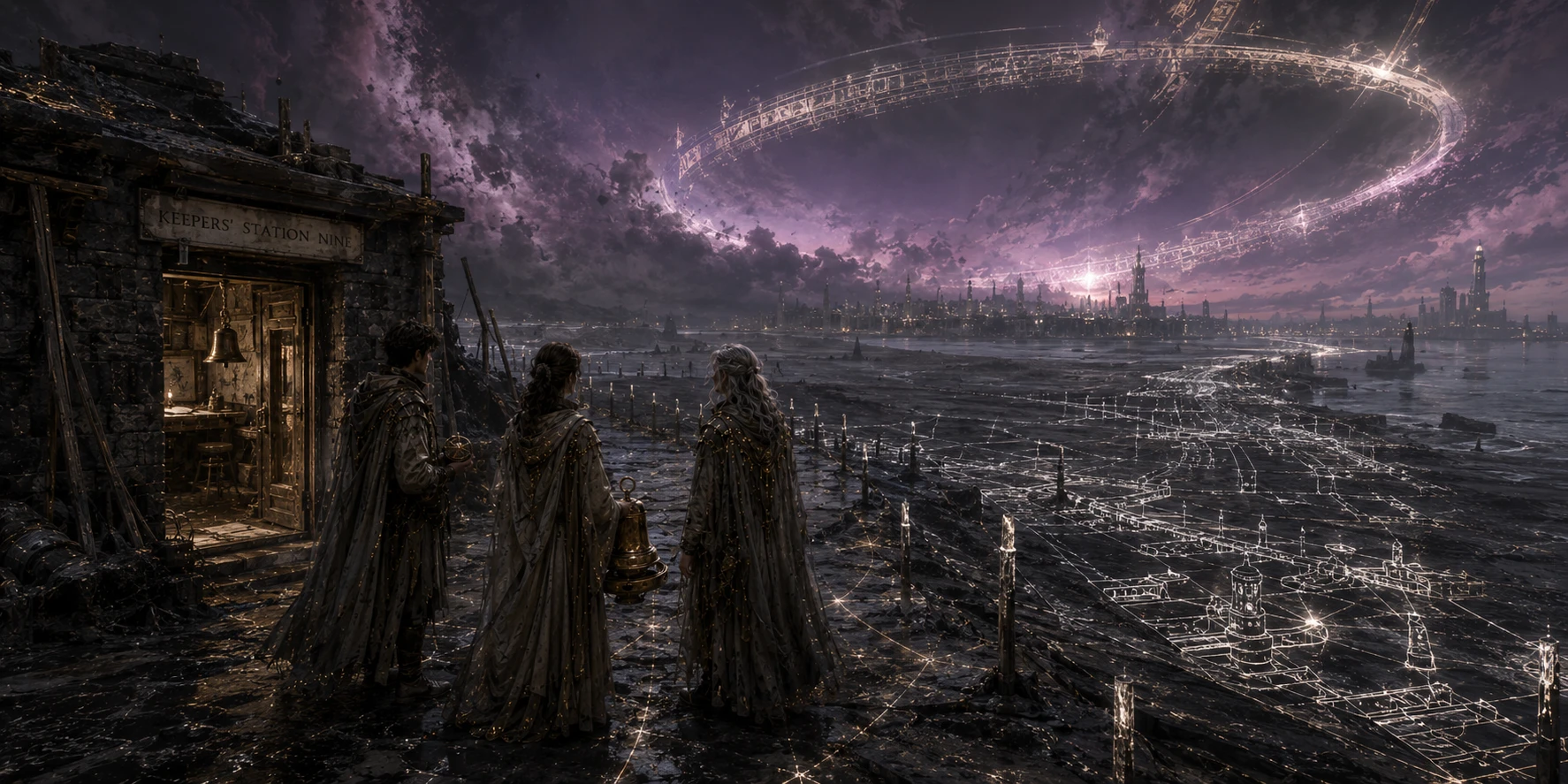
Above the coast, the sky was violet in the way bruised fruit was violet: not a colour the world wore by choice, but one it had been forced into. Something immense moved there, slow and patient, not cloud and not bird and not storm. It cut the upper dark with a measured arc, as though an unseen hand were drawing a circle around the world with a compass too large to hold.
Sere stopped at the lip of the shore and shaded his eyes. “It was there before,” he said. “Just farther off.”
Older Ilyra’s jaw tightened. “No. It was nearer than this. The first time it came down, it took three harbours and a season of maps with it.”
Ilyra looked from the moving thing in the sky to the strip of coast ahead. The ash there was not level. It rose in a shallow mound around a low building of black timber and salt-glazed stone, one half of it sunk into the earth and the other half shored up with poles that had gone silver with age. A sign hung over the door, almost lost in soot: KEEPERS’ STATION NINE.
“That wasn’t in the index,” Sere said.
“It wasn’t meant to be read from inside the city,” older Ilyra answered.
The door opened before they reached it. Not inward or outward, but as if the room had simply decided their arrival was not worth resisting. Inside was a narrow chamber with a drafting table bolted to the floor, three stools, a wall of shallow drawers, and a brass bell hanging from a beam over a basin of clear water. The bell had no clapper. It was a shell around a silence with weight.
On the far wall, pinned under yellowing wax seals, was a survey sheet drawn in a hand that made Ilyra’s stomach tighten. It showed the ash coast, the seam where the first world had opened, and beyond it a small block marked VEYR in the shape of the city she had left behind. Around it were notes in the same precise script:
Do not let the copy believe itself original.
Do not let the original starve for lack of being remembered.
If both names are spoken together, the shore will answer.
Ilyra reached for the sheet and stopped when she saw the signature at the bottom. Not Ilyra Venn. Not Ilya Arnn alone. A line of her own name divided by a slash, then a second hand adding, in smaller letters: kept enough.
Older Ilyra exhaled once, the sound thin as paper. “I left this place because I couldn’t bear to look at what I had done to keep the city alive.”
“What did you do?” Ilyra asked.
“I made a city that could live by forgetting,” she said. “Then I discovered forgetting was a hunger. It never stopped at enough.”
The basin on the table was not empty. Beneath the clear water lay a shallow ring of black glass, and inside the ring, tiny lights were moving in slow, deliberate lines. Not fish. Not reflections. Survey marks, drifting under the surface like ideas too stubborn to drown. As Ilyra watched, they arranged themselves into a coastline she knew. Veyr again. The harbour. The Hall of Measures. The narrow street where the map room windows faced east.
Then the line changed. Another coast appeared under it, older and rougher, with the harbour drawn not as a bay but as a wound in rock. The two shapes held for a heartbeat, aligned and then slightly apart, and in that small difference Ilyra saw the entire lie the city had been living in. Veyr was not the only world. It was the surviving draft.
“The wheel in the sky is the copier,” Sere said softly.
Older Ilyra turned to him. “You know what that is?”
“Not by name. By function.” His eyes stayed on the ceiling, as though the thing overhead could hear him through stone. “It cuts, repeats, and sends the waste to ash. The first survey used it to keep a world from tearing itself apart. Then somebody kept using it after the emergency was over.”
The woman in the ship spoke through the walls, through the water, through the bell without a clapper. “It was never over,” she said. “That is the mistake that made the copy cruel.”
Ilyra looked again at the bell. The brass was worn where hands had touched it for years. Along the rim were tiny dents, each one made by a finger or a tool or a nervous habit repeated until the metal learned the shape of attention. This was not a ritual object. It was an instrument, and it had been used to keep one world from leaning too hard against the other.
She touched it. The metal was cold enough to sting.
“What happens if I ring it?” she asked.
Older Ilyra’s answer came after a pause that felt measured against a long interior distance. “The shore will remember both names at once. That might steady the seam. It might also wake every place the city filed as loss.”
“So neither choice is clean,” Sere said.
“No,” said the older Ilyra. “But one of them is honest.”
Outside, the thing in the violet sky moved again. This time the station shuddered under it. Fine dust sifted from the beam over the bell. The basin on the table trembled and the two coastlines inside it slid closer together, almost touching. Ilyra felt it before she understood it: the pressure of both worlds trying to settle on the same border, the old appetite of the copy and the old grief of the original pressing against one another through her own body.
She took hold of the bell with both hands. The metal was heavier than it looked, weighted by all the times someone had decided a boundary mattered more than a name. She did not ring it immediately. She stood with it suspended between the floor and the beam, between the ash coast and the city that had sent her here, and said the names out loud, one after the other.
“Ilyra Venn. Ilya Arnn.”
The bell rang.
It was not loud. It was complete.
The sound travelled down through the floor, through the basin, through the black seam back to Veyr. The water on the table leapt once, high and bright as a cut coin. The survey marks beneath it rearranged themselves into a single line that ran cleanly from the first world to the second. For one dazzling moment the shore did not choose between them. It held both.
Then the coast outside the station answered.
Every survey peg along the ash line rose at once, as if lifted by invisible hands, and the black glass of the shore filled with thin white lines. Streets. Quays. The Hall of Measures. A map was being drawn in the first world’s dust, and the shape it took was Veyr.
Older Ilyra swore under her breath. Not in fear. In recognition.
“That should not be possible,” Sere said.
“It already is,” the woman in the ship replied, and now her voice sounded tired in a way that made it almost human. “The city has begun to remember where it was copied from.”
Ilyra kept her hands on the bell. In the basin, the two coastlines did not merge, but they no longer drifted apart. A narrow bridge of light held them in place. She understood then that the bell was not a door. It was an anchor. If they carried it back to the city, Veyr might remain itself without forgetting the first world again. But it would never be able to pretend the first world was only a story in a drawer.
She lifted the bell from its hook. The station gave a small, exhausted creak, as though relieved to be asked to bear a different truth at last. Outside, the great thing in the violet sky changed course.
When they stepped back into the ash light, the first line of Veyr’s harbour had already appeared on the far horizon of the coast, drawn in white by a hand that was too large to see. The copy had begun to look for its source. And somewhere behind them, in the open seam, the city was ringing back.