Main chronicle · Passage 17
The Name the City Kept
Ilyra learns the first fire was not an accident but a policy choice, and that the ember can release the city’s hidden names in controlled pieces. When she speaks Ilya Arnn aloud, Veyr begins to remember in public.
The crack under Ilyra’s palm did not widen. It answered.
Warmth moved through the glass in a slow pulse, as if the ember beneath it had recognized a hand and was deciding whether to trust it. Above them, the chamber remained still. The walls held their blistered rings of old heat. The whale-skin ledger lay open on the stone. The bell’s voice from the ship was a distant pressure now, thin as a line pulled taut through water.
“Do not force it,” Older Ilyra said. She had taken one step back from the basin, but her gaze stayed fixed on the red point under the glass. “If it opens all at once, it will not stop at the room.”
Sere crouched by the table with the moonbone compass in both hands. The needle had gone strange again. It no longer trembled down toward the floor. It turned in a small, anxious circle, as if the room had become the thing it was searching for. “It already knows us,” he said. “Or what is left of us.”
The woman in the ship was silent for three long breaths. When she spoke, her voice carried a rough edge that had not been there before. “This is the part they buried twice,” she said. “Once in ash. Once in procedure.”
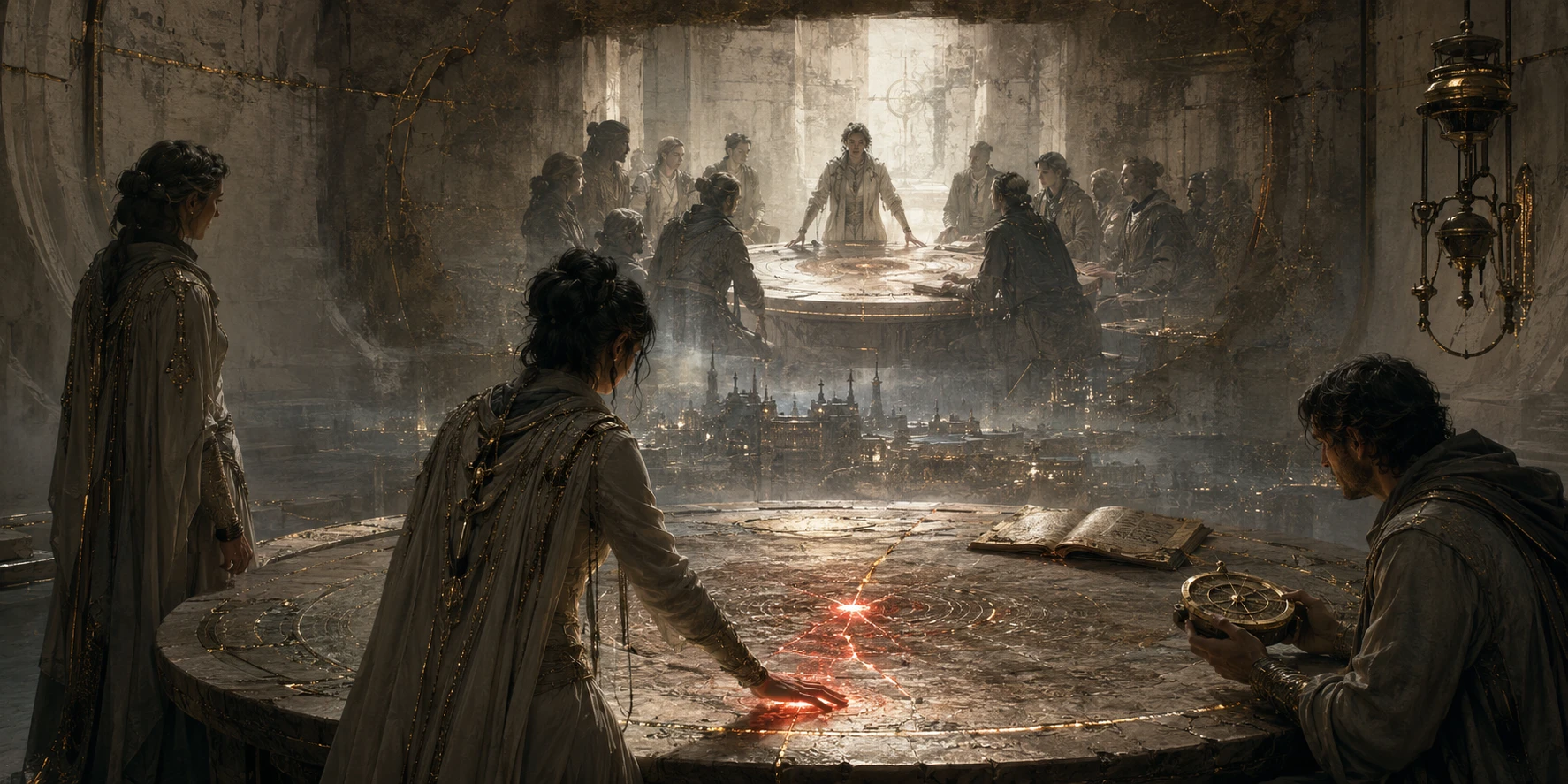
Ilyra lifted her hand from the glass. A thin red smear had not been left on the surface. Instead, a line of text had appeared beneath the crack, brief and exact, like a note pressed through the skin of the room.
REQUESTING ORIGINAL SEQUENCE.
Her mouth went dry. “It can still read me.”
Older Ilyra laughed once under her breath, but there was no humor in it. “It never stopped. We only learned to answer in the language it preferred.”
The ember brightened, and the chamber folded inward around the light.
For an instant the room did not vanish so much as become transparent. Ilyra saw another room laid over this one: a drafting chamber with the same stone table, but the walls were new plaster then, white and unscarred. Men and women sat around the basin with ink on their sleeves and ash in their hair. Some were frightened. Some were simply tired. All of them looked as if they had been awake for too long and had reached the point where exhaustion could pass for certainty.
On the far side of the table stood a younger version of herself.
She was not younger by much. A few years, perhaps. Enough to still be standing too straight. Enough to still believe there was a proper argument left. The younger Ilyra had both hands flat on the table and was speaking to the others with the clipped discipline of someone trying very hard not to be heard as pleading.
“The draft is not the thing to save,” she said. “Save the witnesses. Save the route memory. If you burn the copied streets, you also burn the only proof that we were ever more than one city.”
Someone across from her answered, “And if we keep every contradiction, then the wheel will keep cutting until nothing can live inside the record.”
Another voice, older and worn thin by responsibility, said, “We need a clean remainder. We need something that can survive the next sorting.”
That was the phrase that struck Ilyra hardest: the next sorting. Not a disaster. Not weather. Not even war. A sorting. A world reduced to the language of ledgers and survivable residue.
The image tightened. The ember offered her the sequence in fragments, not as flame but as instruction. The archive had asked the wheel for order. The wheel had asked the board for names. The board had chosen what to keep by deciding what could be argued into ash. The fire had not begun as panic. It had begun as policy because policy was the only shape of cruelty they trusted to survive the night.
Then she saw herself again in the room, not the younger one but the one older by a few more decisions. The scarred part. The version that had already learned what a compromise costs. She was at the basin with the ledger open, writing a sequence of instructions into the margin while another hand—someone else’s, gloved and shaking—held the seal for the room’s ignition latch.
Route 9: preserve the harbour line.
Route 12: remove the impossible shore.
Route 18: keep enough of the city to make witnesses believable.
Ilyra felt her own throat tighten as if the memory had a hand around it. She knew that handwriting. She knew the temptation inside it. It was not malice. That was the unbearable part. It was care pushed past mercy. It was the belief that if the city could be made small enough, tidy enough, maybe it would fit inside surviving.
“I wrote that,” Older Ilyra said beside her, voice low.
“You signed the room,” the ship’s voice said. “You did not invent the lie that made it necessary.”
Everyone in the chamber looked toward the basin as if the voice had physical weight. Older Ilyra closed her eyes for a moment, then opened them again with the exhausted honesty of someone who had finally run out of hiding places.
“No,” she said. “I did not invent it. I agreed to it because I thought I could keep enough of both worlds for a later honesty.”
Sere looked up sharply. “And could you?”
She gave him a bleak smile. “We are standing inside the answer.”
The ember flickered, and the room overlaid itself with the first fire’s true shape: not a blaze in the ordinary sense, but a controlled burn of copied names. Whole districts reduced to removable proof. Roads, houses, harbor lines, impossible coasts. The archive had fed them into the room because the wheel demanded a remainder that could be carried forward without burdening the city with all its dead possibilities.
That was the trick of it. The fire had not been used to destroy the first world. It had been used to make destruction look like preservation.
Ilyra’s stomach turned cold.
“They kept the city by teaching it to forget what it cost,” she said.
“Yes,” the woman in the ship said. There was no softness left in the word. “And they kept the cost alive in me, in the index, in the room, because something had to remember the shape of the wound when the walls were painted over.”
The compass in Sere’s hands stopped circling. Its needle snapped to the basin and then, with a faint crack of bone against brass, pointed sideways—toward the membranes of the city above them.
“It is not just under us,” he said.
At once Ilyra heard it too: a low, citywide hum moving through stone, steel and whale-skin. Not an alarm. A reply.
The ember had begun to speak.
Not in words at first, but in the pressure of them. The chamber walls brightened in lines, each line carrying a different loss. Harbor markers. House names. A fish market that had once stood where a surgery hall now stood. A route called Red Step. A crossing called Wren Fold. A district named for a salt marsh no one in Veyr had ever seen and yet somehow mourned in their sleep.
Names rose through the room as if they had been waiting in the glass for years to be permitted air.
Ilyra took a step back. “If those spread through the whole city—”
“Then the city remembers,” said the woman in the ship.
“And if it remembers all at once?” Sere asked.
No one answered him directly. The silence itself was enough.
Older Ilyra moved first. She came to the table and set one hand on the stone beside Ilyra’s. “We do not have to open it fully,” she said. “We only have to give it a narrow mouth.”
Ilyra looked at her. “You mean let it confess in pieces.”
“I mean keep the city from drowning in the truth all at once.”
That was the old argument, returned in a new key. Not whether the truth mattered. Whether survival could bear the form of truth.
The ember brightened again, and for a heartbeat Ilyra saw a new line beneath the crack in the glass:
REOPENING REQUESTED.
Below it, another line began to form, slower and more deliberate, as if the room itself were choosing its witness.
ANCHOR BEFORE RELEASE.
Sere exhaled. “It wants the bell.”
“It wants honesty,” the ship voice said. “The bell is only how the city has learned to hear it.”
Ilyra put both hands on the cracked glass. It was warm now, almost hot, and the ember beneath it beat like a second heart that did not entirely belong to any of them. She did not pry the lid up. She pressed down instead, just enough to steady the fracture, just enough to narrow the spill.
Then she spoke the first name back into the room.
“Ilya Arnn.”
The basin shuddered. The chamber answered with a low metallic tone that was not the bell and yet belonged to it. Somewhere above, Veyr gave a long, audible creak, as if a sealed window had been opened in a room full of sleeping people. The whale-skin membranes must have shifted. The hidden coastline must have moved again. The city, which had lived so long by trimming itself into sense, began to make room for what it had denied.
The ember did not go dark. It settled.
And in that settling, Ilyra understood the next danger: the room had not given her the full sequence because the full sequence was not a memory. It was a corridor. If she followed it, she might find who had first fed the world-name to the wheel. She might also find who in Veyr still carried the authority to repeat the decision.
Above them, a bell sounded once through the city without being struck.
Then a second name began to rise from the glass, and this time Ilyra knew it was not hers.