Main chronicle · Passage 10
The Room Beneath the Name
Ilyra opens the room under ORIGIN and finds a hidden route into the first world's ash-basin.
The moonbone compass did not point so much as pull. Ilyra felt it dragging at the skin of her palm as the three of them stood over the new mark on the archive map: ORIGIN, inked beneath the Hall of Measures like a word that had been waiting under the floorboards for years. The chamber below them had gone quiet in the way a held breath goes quiet. Even the ship above had stopped groaning for a moment, as if listening for what would happen when the hidden room was finally treated like a door.
Older Ilyra went first. She crouched beside the seam the compass had found in the wall and pressed two fingers into the black line between the stone blocks. The seam gave a soft click. A panel the width of a table eased inward, and a draft came out of it — dry, salt-cold, carrying the smell of old wax and lamp oil. Not the smell of a hold. The smell of a place built to keep paper alive after the world has stopped being kind to it.
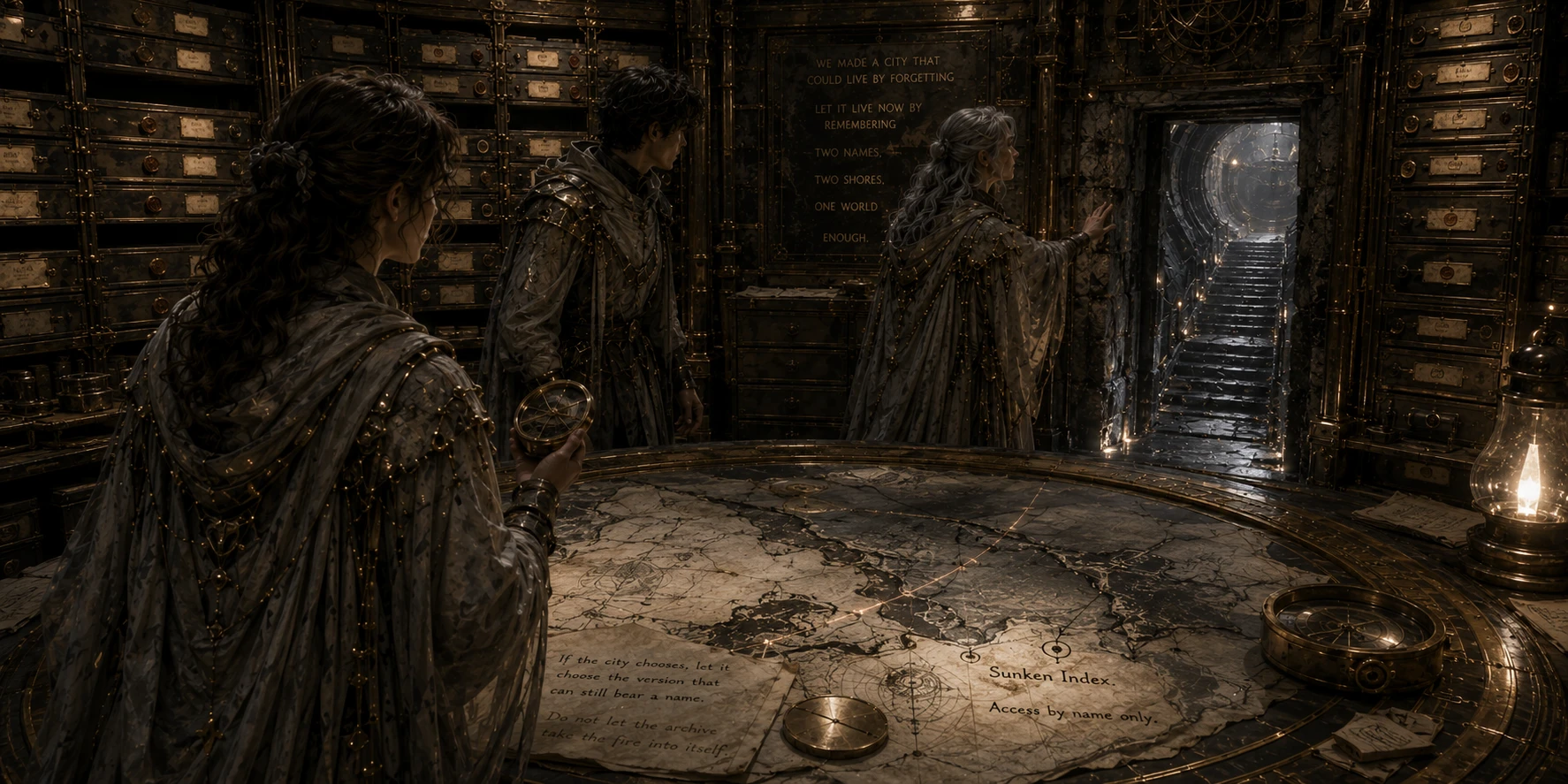
Inside was a room lower than the chamber they had just crossed through, but wider than it ought to have been. It had a low drafting ceiling, shelves of narrow drawers running from floor to beam, a circular table with a brass ring set into its centre, and a wall of pale stone completely free of dust, as if no one had ever dared to touch it. A line of glass lamps burned without smoke. Their light had the thin, patient quality of things that have been lit for so long they have stopped expecting an audience.
“This is it,” older Ilyra said, though her voice did not sound triumphant. It sounded tired in a way that went past tiredness and into recognition. “This is the room we used to hide the first cut.”
Sere stepped in after her, careful not to brush the shelves. His gaze moved over the drawers and stopped at the blank brass tabs mounted to each handle. “Why blank?” he asked.
“Because names were the first things the fire would take,” older Ilyra said. “So we stopped giving it names.”
From somewhere beyond the ship’s hull — above them, behind them, through them — the woman’s voice came again, clearer than before. “You are finally standing in the right room,” she said. “That does not mean you have chosen well.”
“I never met a room that didn’t try to judge me,” Ilyra said, and the answer surprised her with its steadiness.
There was a pause. Then, almost amused: “You wrote that line yourself. Years ago. You were less careful with your mouth then.”
Ilyra did not answer. She was looking at the drawers. Each handle was sealed with old wax, but one tab at eye level had a trace of familiar pressure marks beneath the tarnish, as if a thumb had rested there a hundred times. The shape of the marks made her chest ache before she understood why. She reached for the drawer and older Ilyra caught her wrist for a brief, hard second.
“If you open that,” the older woman said, “you will remember the part of yourself that made this place.”
“That is why I am opening it.”
The drawer slid free with a whisper of wax against wood. Inside was a folded sheet of whale-skin thinner than any map she had seen in the Hall of Measures, its surface stained with a matrix of black lines and salt-brown corrections. It was not one map laid over another. It was one world laid over a second world and then folded so tightly that the edges met without admitting they had ever been separate. The western harbour of Veyr sat over a burned inland basin whose coast looked as though it had been scraped with a knife. The sea was marked not blue but pale ash.
At the bottom of the sheet was a sentence in her own hand.
If the city chooses, let it choose the version that can still bear a name.
Under that, in a line so faint it might have been a correction rather than a confession: Do not let the archive take the fire into itself.
Ilyra read the lines once, then again, and the second time the room slipped sideways around her. She was standing in a long bright chamber with no walls, only a table and lamps and the hard smell of ink. Younger hands — her own hands, but steadier, unscarred by the present — were drawing the very same coastline onto the very same sheet. Someone was shouting from far off. Someone else was laughing, not in joy but in disbelief, because they had discovered that a city could be made to forget if you taught it to call the wound by another name.
She came back with a gasp. Sere was watching her with the careful stillness of a man trying not to frighten a door into closing.
“What is it?” he asked.
“A compromise,” Ilyra said. Then, after a beat: “Or the evidence that one was possible.”
Older Ilyra had gone to the far wall. She stood with her hand just above a set of drawers built into the stone. “I thought I destroyed the rest,” she said. “I thought I took the key with me when I went looking for the first world. I did not think this room survived.”
“You thought wrong,” said the voice from the ship.
Older Ilyra gave a short, humourless laugh. “Yes. That has become a habit.”
Sere found the thing that had been hidden in the drawer beside the map: a brass disk no larger than the moonbone compass’s face, stamped with a thin line across the centre like a horizon. When he set it on the table, the compass in Ilyra’s palm answered at once. Its needle spun once, then steadied, then began to tremble toward the stone wall behind the drawers.
There was a sound like distant wood splitting.
The wall did not open wide. It only loosened, parting by a hand’s breadth to reveal black glass steps descending into a darker part of the ship’s belly. Air came through them in a slow exhale — salt, ash, and something hot beneath both of those things, as if the first world had not finished burning and had simply learned to burn more quietly. The woman’s voice softened on the edge of the opening.
“That passage is not a route,” she said. “It is the spine where the worlds remember each other.”
Older Ilyra stared at the steps. The hard line around her mouth had gone tighter, but not with fear. With the effort of not saying what she already knew. “The basin,” she said. “The one under the ash coast. The first survey never ended there. It was only hidden.”
“Hidden from whom?” Sere asked.
Neither Ilyra answered at once. The answer was in the room: in the blank tabs, in the map folded over itself, in the careful choice not to name what had to survive. Hidden from the city, perhaps. Hidden from the world that wanted only one version of reality. Hidden from the part of herself that had once been willing to burn a memory to keep a street alive.
Ilyra put the folded whale-skin sheet back on the brass-ringed table and pressed her fingers flat to it. The map warmed under her hand. In the pale ash basin, new ink bled up through the surface and formed a narrow route line leading inland, away from the coast and toward a point marked only by a small circle and a word she could not read until the letters settled into place.
Sunken Index.
Below it, almost too small to see, another note emerged.
Access by name only.
Ilyra looked up. The compass had stopped trembling. It was pointing through the opening in the wall, down the black steps, toward the place where the first world’s memory had been stored instead of destroyed. Behind her, somewhere in the archive above, a shelf creaked as if the city had just remembered it was listening.
She closed her hand around the brass disk. Then she took the first step toward the dark seam under the ship, and from inside the hull the woman who had refused to sink said, very softly, “At last.”