Main chronicle · Passage 9
The Chamber of the First Tide
Veyr does not finish choosing. The buried ship opens like a wound, and Ilyra finds the first world hidden in the city’s own foundations.
For a long moment after the whale-skin membranes snapped east, nothing on the harbour moved except the water. It climbed the ship’s ribs in pale threads, then fell back, then climbed again as if the city were testing the weight of its own decision. The black hull had torn a wound through the quay and into the Hall of Measures below. Stone dust drifted from the arches. Lanterns swung on their chains. Ilyra felt the moonbone compass pulse once against her palm, warm as a small animal.
Older Ilyra was already halfway down the broken stair that had opened beside the customs arch. She did not look surprised by the gap. She looked irritated, which somehow made the widening crack in the ground seem more manageable. Sere stood at the top of the steps with one hand on the wall and the other raised to keep the cartographers back. His face had gone pale in the harbour light. Behind him, the living map in the Hall of Measures shivered under its own silk cover and redrew the western harbour twice in quick, nervous strokes.
“If it has surfaced this far,” the older woman said, “then the lower chamber is awake.”
“The lower chamber?” Ilyra asked, and the compass gave a hard twitch toward the black ribs below them.
“The room we built under the ship so the ship would never need to know it was a room.” The older Ilyra’s voice was dry, almost tired. “Come on. Before the city changes its mind again.”
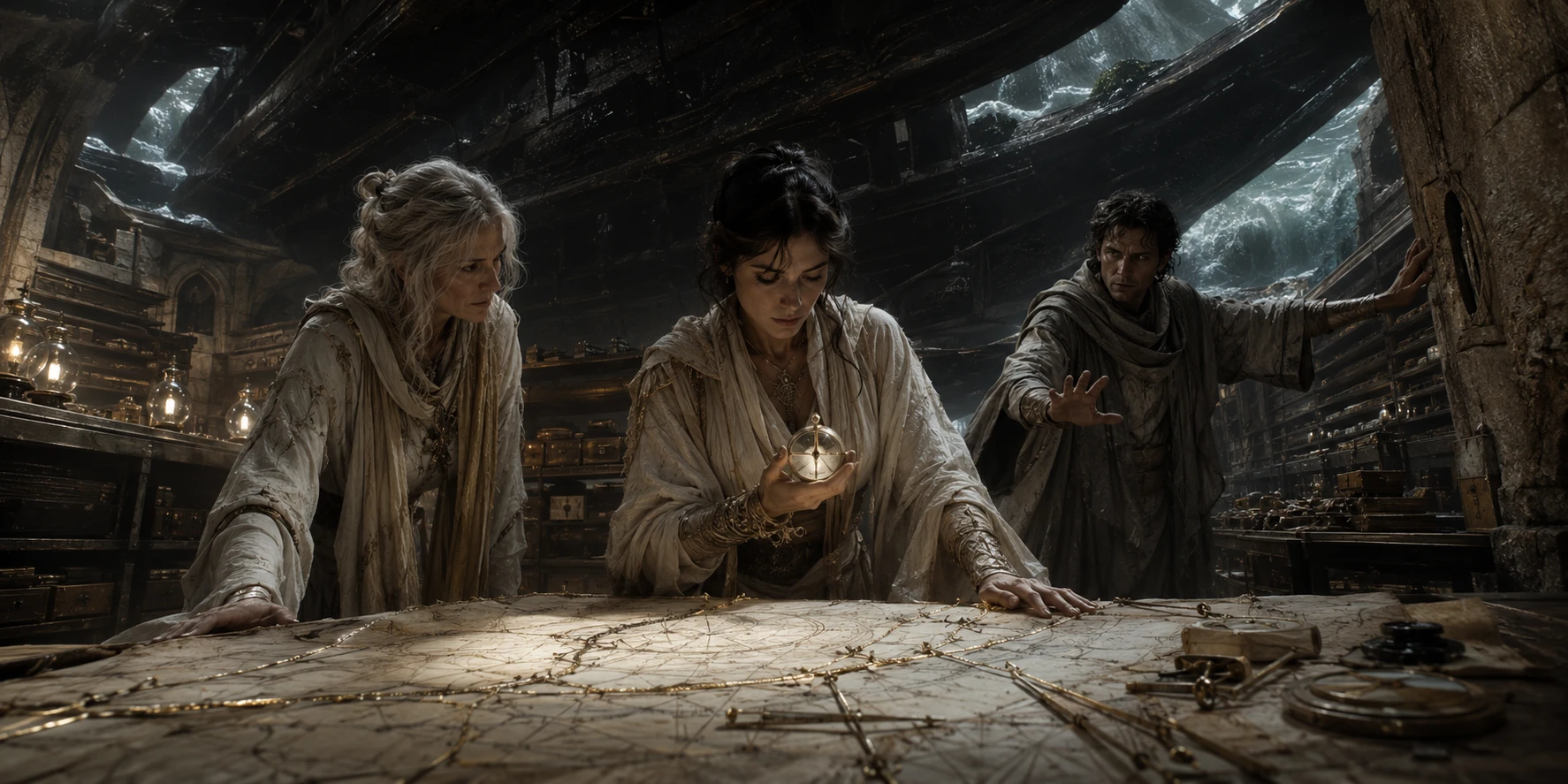
They went down together. The air changed first. It became colder, then saltier, then strangely dry, as though the stone below the harbour had spent years waiting for this exact dampness and now disapproved of being asked to host it. The torn seam in the quay opened into a chamber tucked under the foundations. The ship’s keel passed through its roof in a forest of black beams, but the chamber itself remained intact, lit by a row of glass lamps that had somehow survived every collapse by continuing to burn for no one.
There were shelves in the chamber. Not cargo crates, not ribs of timber, but shelves. They ran from wall to wall in careful lines, each one holding sealed map cases wrapped in waxcloth. Some bore old labels scratched into copper. Some were blank. One wall held a long table littered with compasses, dividers, and strips of parchment pinned under shards of shell. In the far corner, behind the table, a narrow slit of light showed the black side of the ship and the water shivering past it at a wrong angle, climbing where water should not climb.
“This is not a hold,” Sere murmured.
“No,” said the older Ilyra. She reached out, touched a map case, and for a moment her hand lingered on the wax as if she expected it to answer. “This is where the first survey ended. Or where we pretended it did.”
From somewhere inside the ship, beyond the thickness of its hull, the woman’s voice came again. It was muffled now, but still clear enough to be understood. “You are taking the long way to the truth, as usual.”
Ilyra turned toward the sound. “Who are you?”
Silence answered first. Then: “A warning, mostly. And the part of the crossing that refused to sink.”
Sere stepped to the table and set the living map case down beside the compass. Its needle was no longer pointing at the ship. It had gone hard east, into the wall, then begun to tremble toward a narrow seam between two ribs where the black paint had cracked away. Ilyra knelt and touched the seam with two fingers. The metal under her skin went cold.
The room vanished for one heartbeat.
She was standing in a long chamber with no walls, only a drafting table and a row of lamps. Her own hands were younger there, ink-stained and steady. On the table lay a map the size of a bed. Veyr was spread across it in pale lines, and underneath those lines, faint but undeniable, another coastline showed through, darker and older. Someone was saying her name from far away. Someone was laughing softly, not kindly, because they had just discovered that a city can be made to forget by drawing over it often enough.
The vision snapped away. Ilyra sucked in a sharp breath and found the older version of herself watching her with a face that had already made the same mistake once.
“You remember now,” the older woman said.
“I remember enough to know I did this.”
“Yes.”
They stood among the shelves while the ship groaned above them. The sound was deep and patient, like a great door being shifted in its frame. Water found another crack. A thread of it ran across the chamber floor and curled around the table leg. The first world was pressing closer. Not through a portal. Through the seam of the city itself.
Older Ilyra pulled one of the blank map cases from the shelf and set it down between them. Inside was a folded sheet of whale-skin, thinner than the rest, and on it a route drawn in black ink. Not a route to the first world. A route around it. Around the burn, the scar, the impossible depth of memory that had made Veyr what it was. Along the bottom edge, in a hand Ilyra recognised with a jolt of cold shame, were words she had written before she forgot how to write them:
If the city chooses, let it choose the version that can still bear a name.
Sere looked from the line to Ilyra. “Is that your handwriting?”
“It was,” she said.
“And?”
“And it is now, apparently, a question.”
The chamber shook. Somewhere above them, the harbour crowd shouted. One of the cartographers cried out as the western edge of the quay began to pale, its stones losing colour as if someone had wiped a thumb across wet ink. The first world was not arriving all at once. It was chewing through the edges of Veyr, one measured piece at a time. If it kept going, the harbour would not simply open. It would be replaced.
“We do not have enough city to keep both,” the older Ilyra said, and for the first time her voice was roughened by something like fear. “We never did.”
Ilyra looked at the map case, then at the shell of the ship above, then at the black water climbing the ribs as if it had found a path home. She thought of the blank space where the western harbour had been in the old map. She thought of the other shore under the violet sky. She thought of a city built to hide a wound until it became a wall.
“Then we do not keep both,” she said. “We keep enough.”
It was not a heroic sentence. It sounded almost practical, which made it more powerful. She took the silver dividers from the table and handed one to Sere. To the older Ilyra she gave the moonbone compass. It answered immediately, its needle trembling so hard it seemed to vibrate rather than point. The three of them moved at once, because the choice had already begun to solidify around them.
They cut the whale-skin sheet into long strips and threaded them through the seams of the map cases. Older Ilyra braced the hull while Sere fed the strips through the joints of the cracked table and into the narrow spaces between stone blocks. Ilyra used the compass as a guide, not for direction but for pressure. Where the needle pulled hardest, she stitched. Where the water rose, she folded the map inward. Where the memory threatened to spill, she anchored it to the nearest named thing: harbour, stair, lamp, wall, hand.
Above them the black door at the waterline thinned. It did not vanish. It narrowed, first to a slit, then to a trembling line of light as the ship’s seam took the pressure that the harbour could not. The climbing water slowed. The pale stones at the quay stopped disappearing. The western edge of Veyr stopped being rewritten and began, reluctantly, to hold.
When the last strip was tied off, the room fell still. The ship groaned once more, then settled with a long, exhausted sound that ran through the foundations and out into the city like a breath finally released. Somewhere above, the crowd went quiet. Then came the small, uncertain noises of people realising they were still alive.
Ilyra lifted the map from the table. Under the fresh stitches, a new chamber had appeared on the drawing of the Hall of Measures, one that had not been there before. It sat below the main archive, exactly where the ship’s keel had punched through stone. Its label was written in her own hand, and she did not remember writing it.
ORIGIN.
The compass turned in her palm and pointed straight down.